wanx-troopers
Wan Animate And MoCha
Wan Animate and MoCha serve similar goals.
See also: Bernini which can perform character replacements too among other video transformations.
SCAIL-2
2026.06.23
WanVideoNAG now works with SCAIL-2 on default settings.
for multiple characters (multiple references have so far been used for same character viewed from different sides):
Don’t do the reference tracking on a batch, it’s treating it as 3 frame video. The reference should be single image instead, can just concat them.
They trained it with only single ref IMAGE. The multiref feature wasn’t trained in, but it somewhat works with single subject at least the actual trained multi people is the color coding.
Q: does the reference need to be the same aspect ratio as the driving animation?
A: [probably] so
Q: scail do lipsync?
djbfilmz A: Yea, it’s not bad. Not as good as IntTalk because it’s doing it pixel based on not on actual sound, but it’s pretty good.
2026.06.11
DPO LoRA - extracted from some sort of a SCAIL-2 finetune HF:Comfy-Org/SCAIL-2:wan2.1_SCAIL_2_DPO_lora_bf16
it can improve things like hands and faces in the results; experiment with different strenghts as it may not apply exactly as intended at 1.0 in comfy
GH:kijai/ComfyUI-NativeLooping_testing contains looping nodes
which may later be merged to comfyui main. These nodes enable looping workflows for SCAIL-2
constructed like this
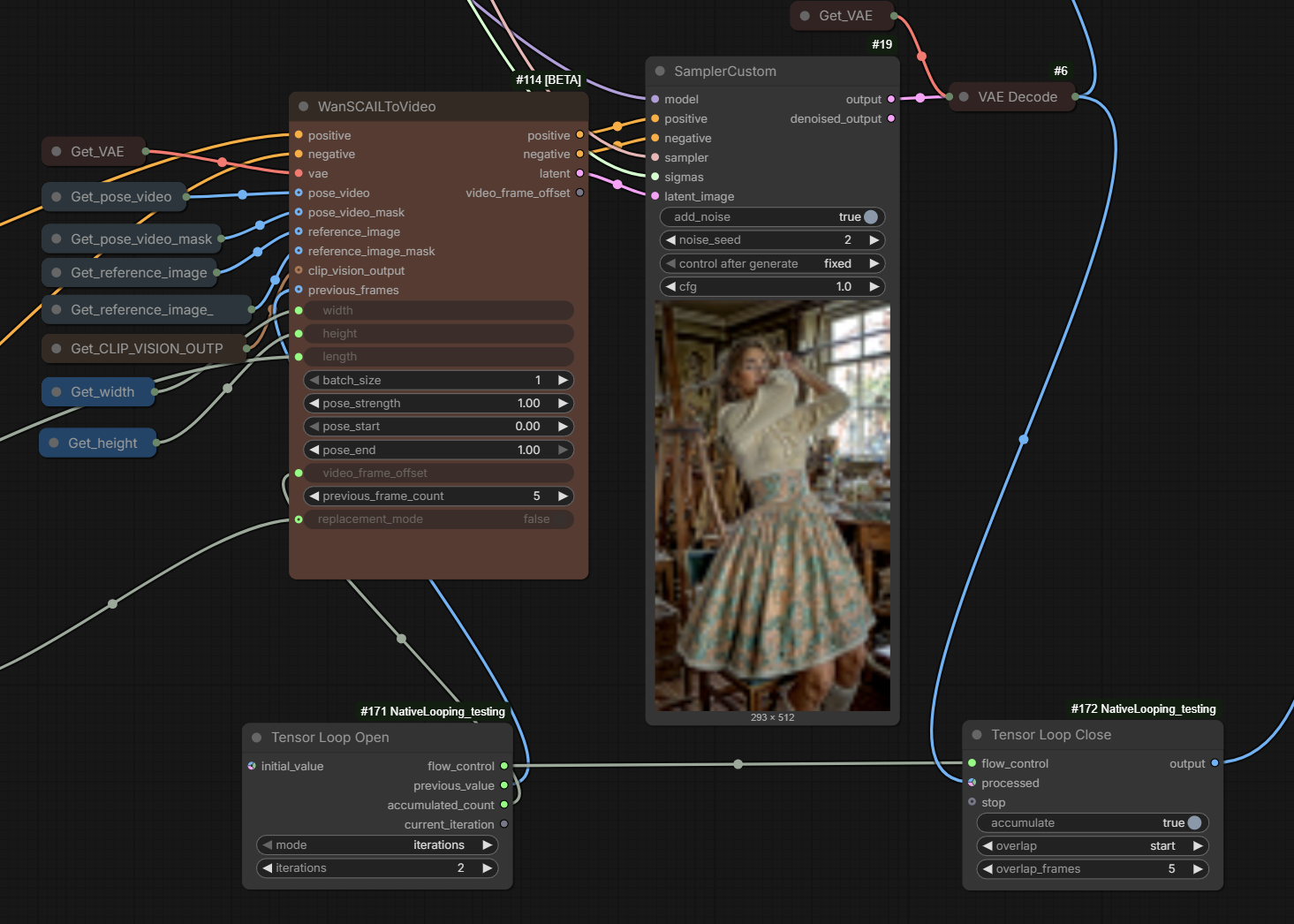
The loop nodes don’t really do anything different than just doing the extension with multiple sampler groups does, just makes it cleaner to do
pose end setting … should work with 1.0, it’s more a inference time saving setting as you really don’t need the last steps to use the pose
Actual WF: Wan21_SCAIL2_looping_test_KJ_01
SCAIL-2 Replacement
Replacement - keeping the background from original video while putting a new character well does not always work perfectly. Suggested ways to improve:
- add DPO LoRA (see above)
- “… and then also switched the clip vision encode to use only the character on black bg”
- “lightx2v at 0.5 [down from 1?] strength brings the bg even closer, but animation suffers”
SCAIL-2 Main
June 2026 SCAL 2 has been released and support merged into ComfyUI native.
- HF:Comfy-Org/SCAIL-2:diffusion_models
- HF:Comfy-Org/SCAIL-2:diffusion_models/wan2.1_14B_SCAIL_2_nvfp4_mxpf8_mix mix of nvfp4 and fp8 from Kijai
Important note on masks and colors: GH:zai-org/SCAIL-2#mask-semantics “For single character it’s the blue mask on white bg for replacement, black for animate mode, and reference bg always the opposite of that with same character id”
Nodes:
WanSCAILToVideoCreate SCAIL-2 Colored MaskWanAnimatePlus SCAIL_2 Embedsfrom GH:wuwukaka/ComfyUI-WanAnimatePlus
it uses colored masks to distinguish the different people
it’s very versatile, works with all kinds of pose rigs or none at all
extension like WanAnimate, so don’t have to use the super slow context windowing
the sam3d-body code is quite extensive so it’s taken a while, but it’s also almost in the core…. fully dependency free implementation; but you don’t need it to use this model, just sam3 that we already have
will also work with multiple people in the shoot? yes
- WF part of this merged PR#14373
- WF: kj-Wan21_SCAIL2_Testing
- Merged PR#14394 including WF - improves context windows support for SCAIL-2
- Simple SCAIL-2 character replacement WF from VK VK_Wan21_SCAIL2_V
- Produced a nice pig video kj-Wan21SCAIL2_ContextWin_v1
- WF from asd: asd-scail-2 smooth dancing dogs
- droz_scail2_looping_extension_v1.1
- Multiref
- GH:user-attachments:Wan21_SCAIL2_multiref_test taken from PR#14509; this is possibly very similar kj-scail2_multiref_context_test
- Another from Dream Making: DreamMaking-Wan21_SCAIL2_multiref_test “but it is only multiref one character; I have no idea if it is possibile to do the same with multiple character AND multiple refs with SCAIL 2”
- …and one from Flipping Sigmas FlippingSigmas-Wan21_SCAIL2_multiref-Trent - with context windows
Wan Context Windows (Manual)standard 20ish frame overlap for 81 frames;
context_overlap: 20 or 24
context_schedule: standard_uniform
freenoise: true
freenoise is probably always good and should probably be default on
on Context Windows vs extensions:
if it’s like WanAnimate it’s the only choice after some length anyway; the extensions can’t hold the full quality
slmonker about reference image:
for the replacement task of scail2, better to use black bg image
will it not OOM?
If it’s a simple video you can increase the detection interval … The detection on every frame slows it down but it’s needed when there’s any occlusion etc. Or if object appears later
Draken: “scail2 is such a good example of, ‘just skip the whole trying to make a skeleton from the input, just use the input’”
ucren:
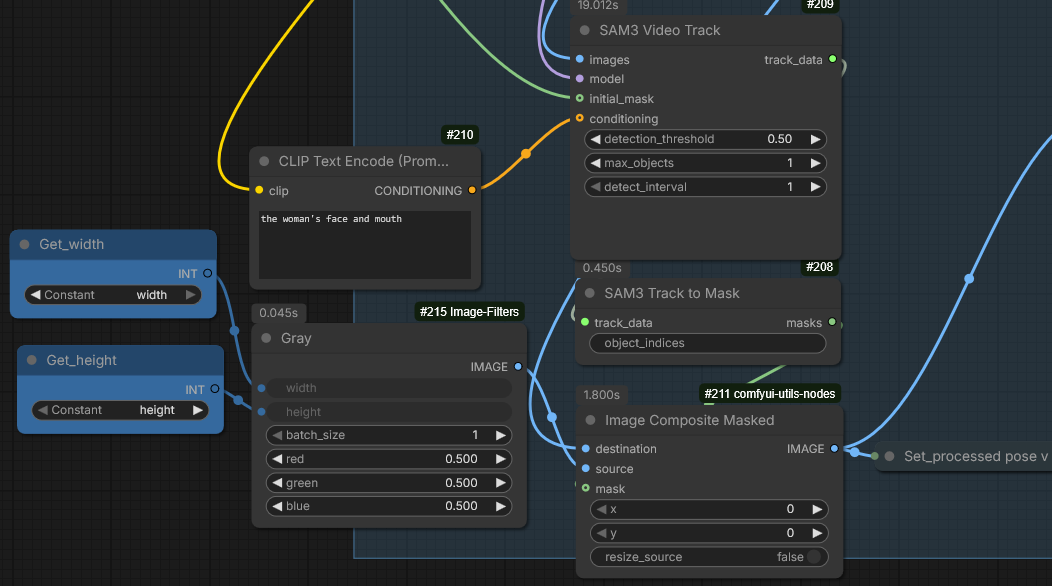
scail2: id persistence is much better if you paint over faces in your driving video and just let scail-2 animate them on its own. i find that scail adopts the shape of the mouth and nose from the driving animation too much” ucren-paint-over-face-mouth sam supports an initial mask … like i just draw a mask over the face and pass that to sam3
I honestly couldn’t really tell a difference between extensions, or context frames [context windows] in my tests. scail-2 is already really good at consistency … there are people out there using it like svi without any driving animations to create consistent long extended I2V context frames was mainly a lot slower
Trained with mixed resolutions and fps. End-to-end driven supports both 512p and 704p. Pose-driven performs better under 704p. H and W should be both divisible by 32 (e.g. 704*1280) if using other resolutions.
Scail-2 follows best at the exact dimensions it was trained on, this model has a tendency to distort at anything but - including adding bars / wrapping the video around edges. So I religiously use 512x864 or 704x1280 and nothing else.
Read their note:
Trained with mixed resolutions and fps.
End-to-end driven supports both 512p and 704p.
Pose-driven performs better under 704p.
H and W should be both divisible by 32
(e.g. 704*1280) if using other resolutions.
Visionmaster2:
It works really well at 1792 by 656 for me
SCAIL2 was trained to accept a fixed number of frames (specifically 5 frames) as a clean history at the start of the video to allow for extending. The
video_frame_offsetis just a way of telling the node how far along in the pose/mask videos it should be grabbing the frames for that generation.
SCAIL-2 Multiple References
Multi-reference for SCAIL-2 has been merged to main branch for Comfy 2026.06.
Before it was merged multi-reference could only be used via a 3rd party node. Following paragraph relates to that pre-comfy 3rd party node.
Up to 5 including one for background. Views of the character from different angles are ok as separate images. Slmonker’s wf: slmonker-scail2-multi-ref-testing. Above wf requires: GH:wuwukaka/ComfyUI-WanAnimatePlus. Recommended specifically to use HF:Kijai/WanVideo_comfy:main/umt5-xxl-enc-fp8_e4m3fn.
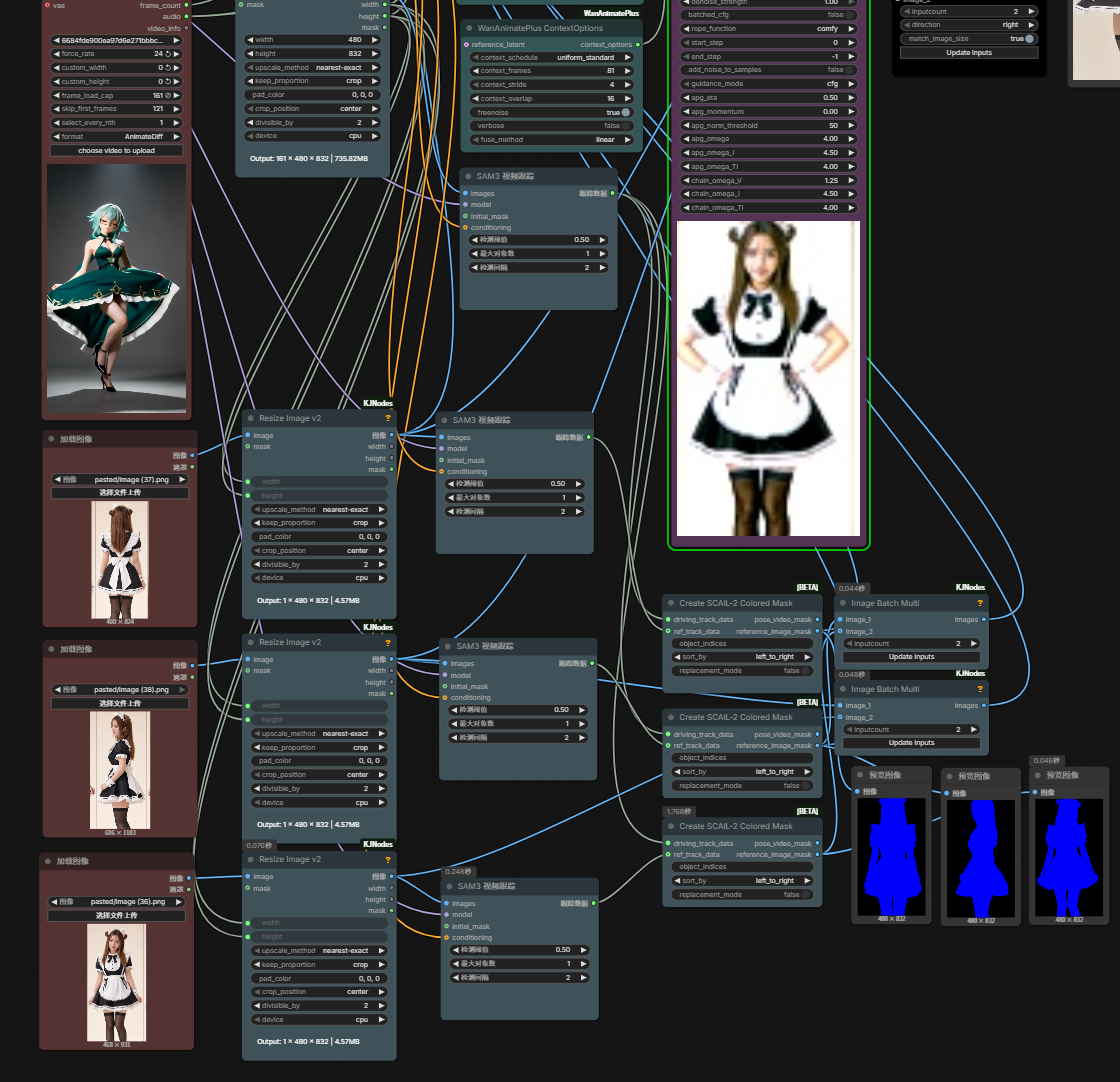
seems working
PhoenixRisen:
You have to match the size and location [of reference image to 1st frame of driving video; when using SCAIL-2 for replacement]
just realized the reference image must be the same size as the video or else background might have issues
BNP4535353: “res-muti simple”
SCAIL-2 Vs Bernini
SCAIL doesn’t use start image so it works way better, the issue is just the background needing to pretty much be static, no camera moves, and it’s S L O W
though in replace mode where background is also driven it should be fine; it’s easily 3-5 time slower than normal gen of same length
OLD: 2025 Universal Pose Scaling
A common issue with this series of models is that the proportions of the character in the video where the pose is being extracted from differ from the proportions of the character being animated.
Kijai has added a universal node that can be used with a number of models on this page.
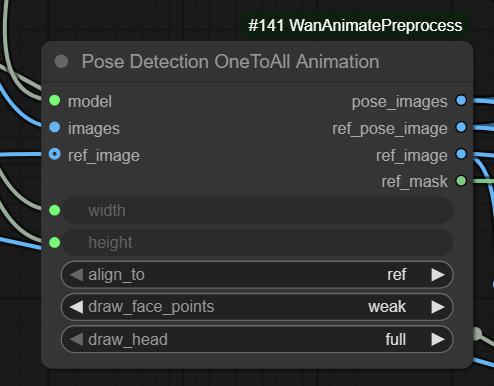
Because the node was developed in the context of One-To-All
it has been named Pose Detection OneToAll Animation.
it doesn’t seem to do that mad limb stretching at least
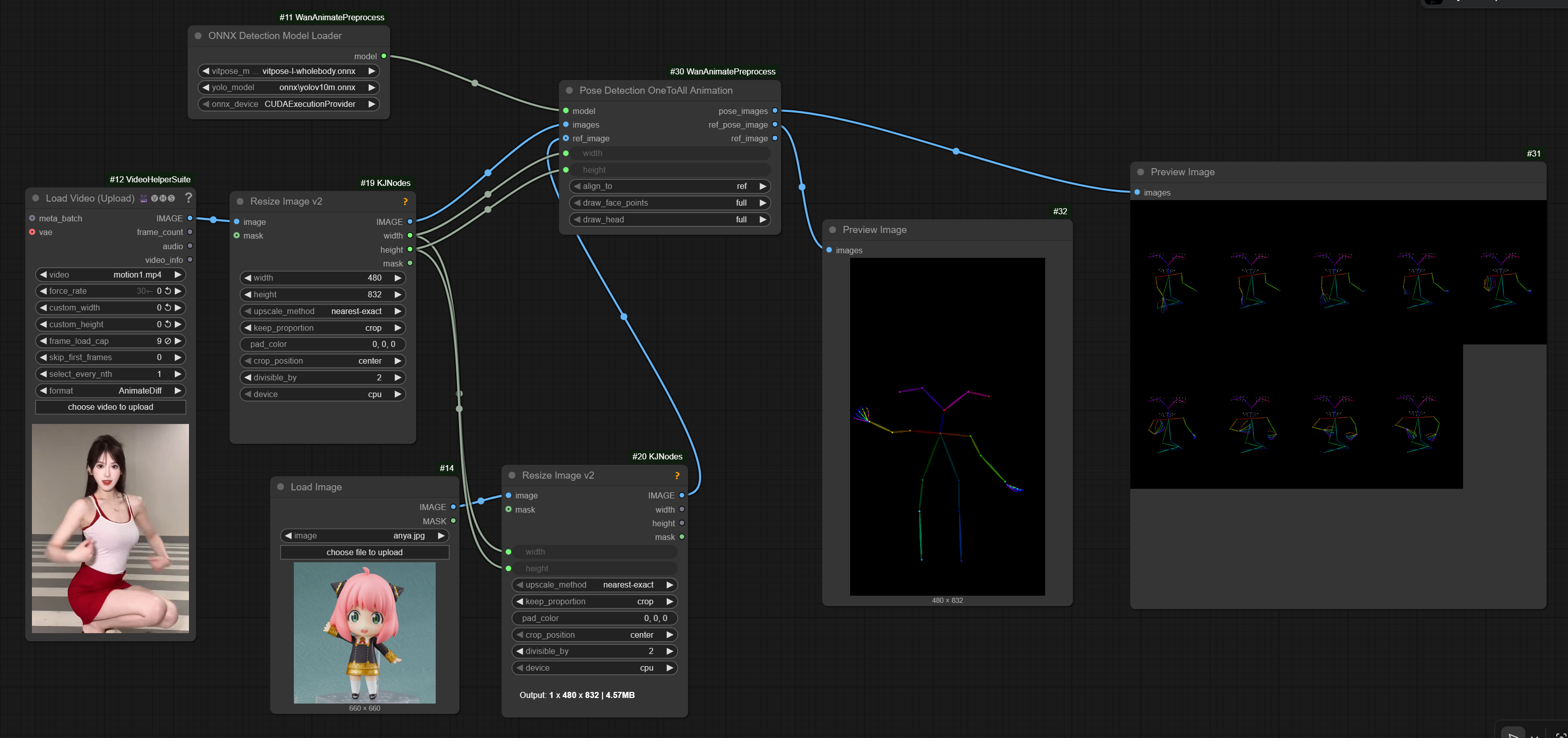
SCAIL-1
2026.05
EverAnimate released. Seems to be a LoRA aimed at improving consistency when using WanAnimate.
djbfilmz:
I used Sapiens for posing with Animate and found it to be the best, followed by SDpose, then DWpose.
Official git repo - pls. put starts to make it easier for the team to obtain more resources for future training!
Q: For EverAnimate, do the stages, 1,2, and 3, go into the lora loader?
slmonk A: No. The team said they trained two versions for 480p due to unsatisfactory results. They recommend using either the 480p Stage2 or the 720p LoRA
SCAIL 2025.12.17
SCAIL generations are known to come up super dark if pose video hasn’t been converted to exactly 1/2 of resolution of the video being generated
Multi-people workflow by Slmonker.
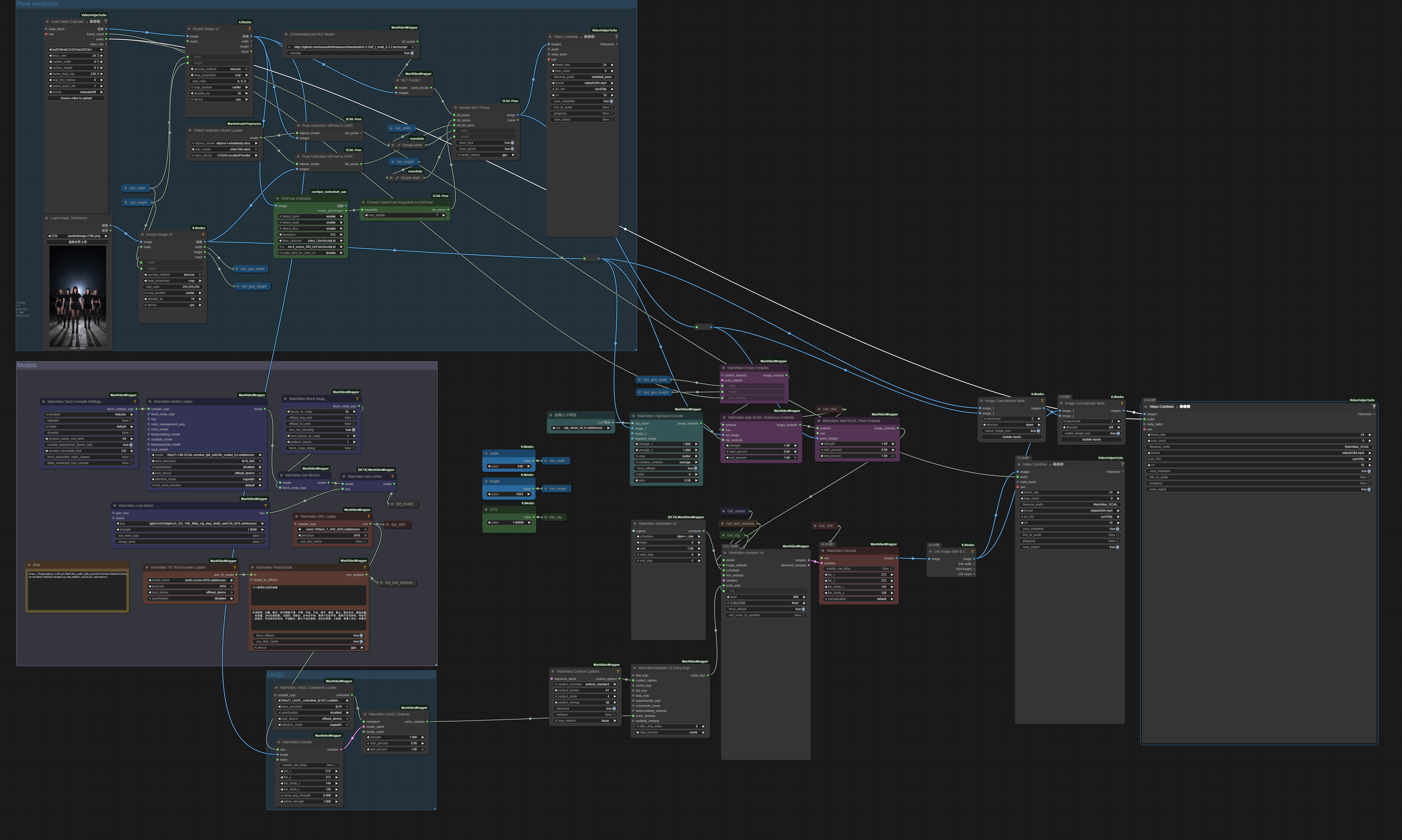
Using Uni3C may help avoid background issues in Context Windows generations with SCAIL. Can be sufficient to use only for initial 1-2 steps of sampling.
Hybrid workflow from Juan Gea: human_video -> SCAIL -> WanAnimate; helps if character proportions very different from original video; the idea is SCAIL workflow can be better at retargetting motion from human to character and WanAnimate is better than SCAIL at keeping a consistent background; “can add Uni3C to the mix, to be sure that the camera is stable and the character won’t slide, for that you use the original human video”.
SCAIL relies heavily on prompting. Good idea to separate prompts with | on wrapper when using Context Windows to apply different prompts to different windows.
As of now SCAIL is not supported on native.
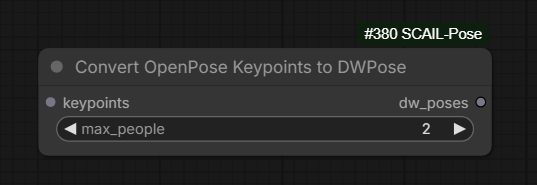
Q: are we at a place where we can two subjects? A: you can but you have to switch to using the dwpose node instead of vitpose if you want faces, as vitpose does only one person at a time
Good starting picture, possibly built from 1st frame of a human video using depth controlnet for Z-Image can help.
The background generally only shifts if the camera moves away from the original background
Q: for SCAIL embeds, is the end percent of 0.5 in the example workflow for speed or because control on all steps looks bad? A: speed and that it has no big effect after that
Using vitpose
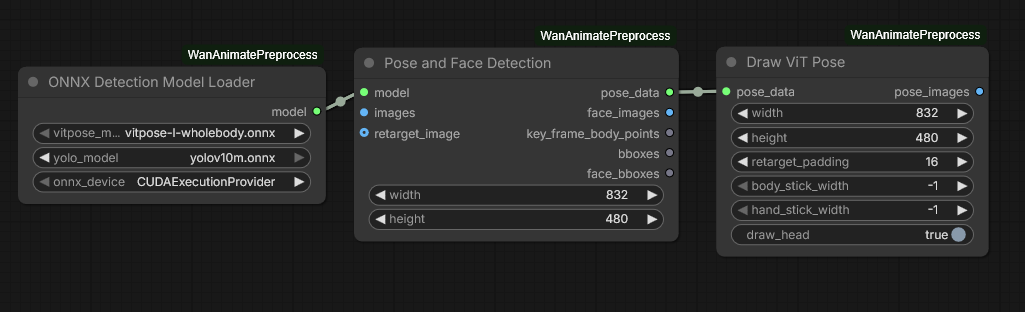
dwpose is just worse than vitpose-H (the huge one), but vitpose also only does one person while dwpose can do more
Note: vitpose .onnx and .bin files go into ComfyUI/models/detection folder, “same with Yolo actually”.
SCAIL-Pose does both NLF and dwpose to add hands/face
SCAIL 2025.12.15
- NLF input only = no retargeting
- no face or hands NLF input + dw_pose = no retargeting
- hands/face optionalNLF input + dw_pose + ref_dw_pose = retarget, hands/face optional
NLF Predict node now has per_batch setting which runs pose estimation in batches reducing overall resource requirements.
1080 looks way better [than 720, this was a vertical video so this is the longer vertical dimension]
disconnect the ref_dw_pose when doing multiple people … vitpose even [does not] return multiple people now?
Q: how would the other skeletons be colored in cases past 2? A: we just have 2 colors, but we do like 1-2-1-2-1-… manner from left to right
SCAIL 2025.12.14
it’s I2V model basically, but input channels are 20
When using uni3c with SCAIL we may need 4 more frames in Uni3C guidance because “scail ref takes one latent”.
4 more frames at the very beginning right? yes; 4 more empty frames? 4 more anything
After latest updates SCAIL is working with Uni3C.
Single-person pose detection working. Add kijai/ComfyUI-SCAIL-Pose code repository, workflow, workflow again.
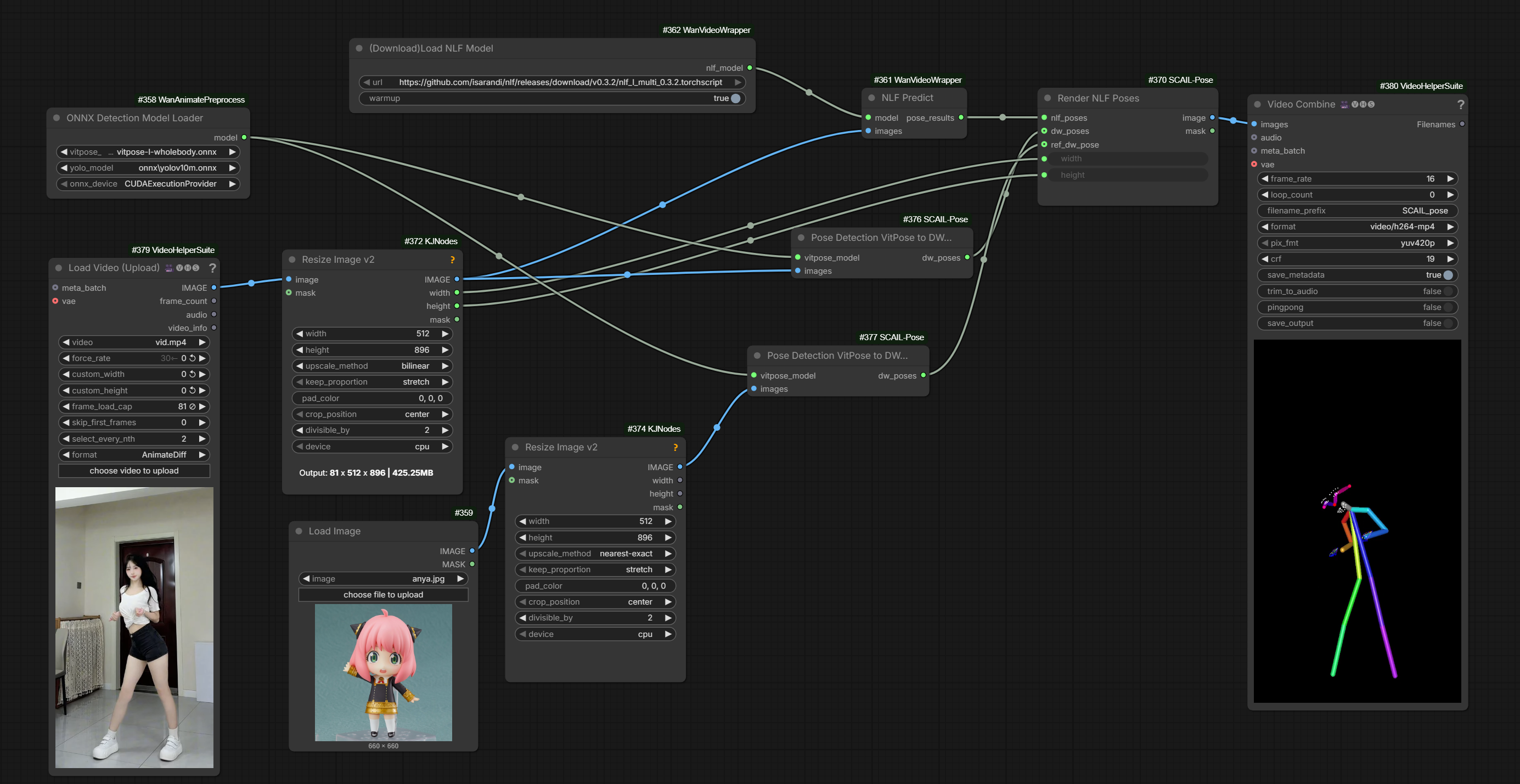
Work ongoing on multi-character pose detection.
the pose input need to be half the resolution of the main input; the whole thing is in same input sequence, [ref, noise, poses] that’s why it’s downscaled too, to halve that impact
Working resolutions: 896x512, 576x1024(?), 1280x704 and same resolutions with W/H swapped.
resolutions needs to be divisable by 32
diffusers and native comfyui do padding [when resolution does not match] wrapper just errors
SCAIL Summary
SCAIL is a new model similar to WanAnimate but able of handling two characters at once. It has been intgrated into the Wrapper.
the pose predictor uses 3D and stuff, probably will have to be separate repo, though it’s just pyrender and that’s not too bad; it uses “warm” on right side and “cool” on left side, which seems important
Model weights.
[pose] doesn’t need to be retargeted as badly as other models
by default the pose is downsampled to half the size, as it’s heavy otherwise, and the default res is 895x512; because the model has separate patch embed for pose, it doesn’t have to match in resolution, but in the code currently either full or half size only are supported
for SCAIL the lightx2v 2.1 I2V
Official SCAIL code is relying on Neural Localizer Fields model to derive human pose from existing videos.
That is the part that is not yet implemented in Comfy. .pt file for the model available from GH:isarandi/nlf/releases.
NLF model license … means you can’t use it … in commercial capacity … research only license
One To All
2025.12.09
Extended length generations implemented, implementation in Kijai’s wrapper complete and merged to master.
613 frames with One-to-all, sadly it does still burn, at least with lightx2v; though it also seems you can just stop the pose control after few steps and then it keeps the ref better; with lower lightx2v strength, lower shift, ending pose control early the burnin is not as bad, but do lose some quality otherwise
Earlier
Experimentation started with One-to-All-Animation. Goals similar to WanAnimate.
it’s T2V based; pose is via controlnet
for reference it uses concat to front, reference attention and token replacement; probably the most complicated … after S2V
the image cond encoder is hunyuan VAE; the controlnet is Wan forward block; ref extractor is basically mini wan of 7 blocks
token replacement [means] set timestep of next 2 frames after the reference frame to 0 to avoid them changing too much from the init; token replace is only used when continuing from previous frames
- Kijai’s adaptations: FP16 38Gb, FP8
- Sample WF, (original test wf)
- You may also need nodes from kijai/ComfyUI-WanAnimatePreprocess
2 modes, either it aligns the input pose to reference, or reference to input pose
Long generations not yet implemented as of 2025.12.08 but once they are the model could become a lot better than WanAnimate: “WanAnimate degrades over time”.
Makes of the model are using 576x1024 resolution in the examples.
shift 7 with euler; when using lightx2v none of that really matters, just have to test and see what works
~15 mins on 4090 at 576x1024; with lightx2v 2 mins; tried 50 steps now but didn’t really improve
the reference adherance suffers greatly from misaligned pose, and also some from lightx2v
Wan Animate
2026.06
Wan_Animate_God_Mode_V3.json wf used by ASD for WanAnimate. asd additionally shared loop asa top-up wf. Also Dream Making’s Wan-Animate-Native-Refiner wf.
2026.03.21
WanAnimate has been implemented on native, workflow: droz_WanAnimate_ContextWindows_Native_v1.1 by hidden-knowledge.md#drozbay.
2025.01.06
It has been reported that counterintuitively setting tiles to 2 in WanVideo ClipVision Encode improves WanAnimate’s ability to generate character looking like reference
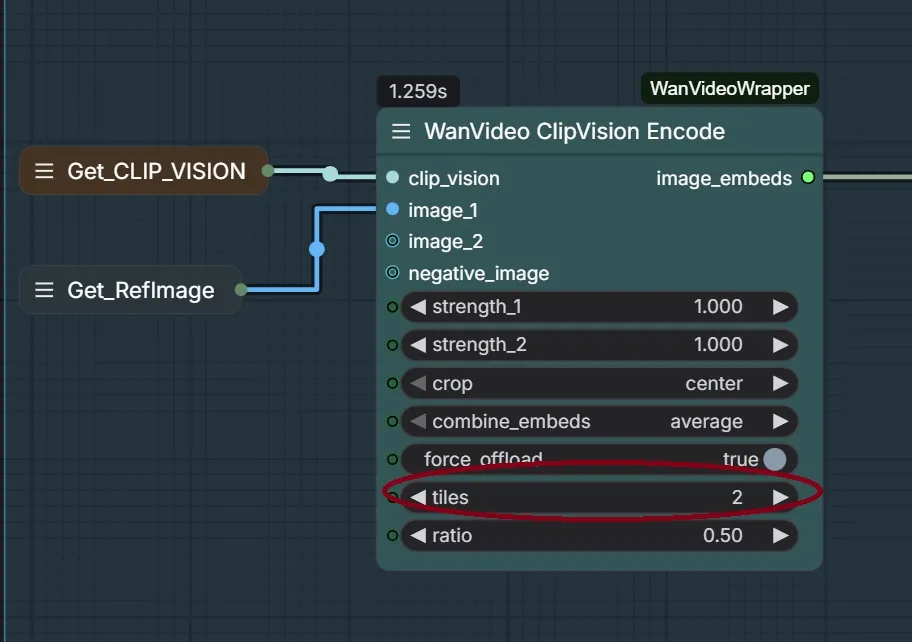
It breaks the image into tiles so clip vision sees more detail; Clip vision images are capped at 256x256, so if you set it to 2 tiles it sees 512x512 (2 tiles = 2x2 tiles essentially)
2025.12.08
Pose Detection OneToAll Animation node can be used with WanAnimate too if face points are disabled
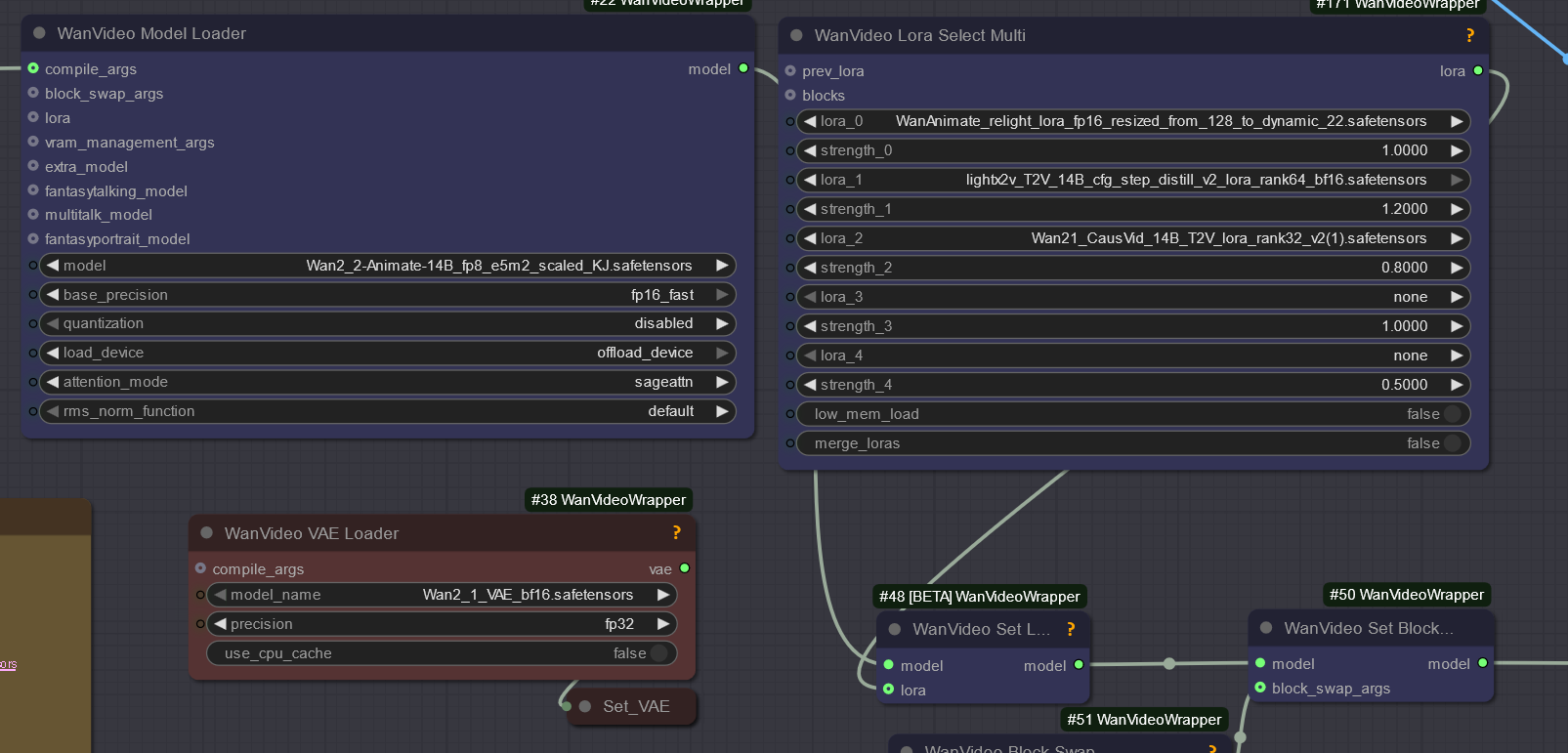
One possible set of LoRA-s: jf-wan-animate-loras.
Summary
Two example workflows given in Github:kijai/ComfyUI-WanVideoWrapper:example_workflows.
Example workflows differ in pose detection tech they provide.
Github:kijai/ComfyUI-WanAnimatePreprocess github repo was used to work newer pose detection tech for WanAnimate.
Not clear if that repository is still relevant.
As of now this example_workflow folder in that repository only contains a native workflow
- which may still be of interest.
hf download Kijai/sam2-safetensors sam2.1_hiera_base_plus.safetensors # models/sam2
hf download Kijai/WanVideo_comfy_fp8_scaled Wan2_2-Animate-14B_fp8_e4m3fn_scaled_KJ.safetensors # models/diffusion_models
hf download Kijai/WanVideo_comfy LoRAs/Wan22_relight/WanAnimate_relight_lora_fp16.safetensors # models/diffusion_models
Important:
- either have both BG and mask connected (background from driving video)
- or have both BG and mask disconnected (background from reference image)
There are two ways to produce longer videos in a batched manner: with and without Context Windows:
| Option | WanVideo Animate Embeds |
WanVideo Context Options |
|---|---|---|
| A | set frame_window_size to you batch size, say 77set num_frames to the length of the video you want to generate |
not used, looping is done “internally” by WanAnimate code |
| B | set both frame_window_size and num_frames to the length of the video you want to generate |
set context_frames to your batch size, say 77 or 814 is possibly correct value for stride effectively setting it to ‘disabled’ |
Pro-s and cons:
- A, looping done “internally”: “won’t shift so much or nothing at all, but from 3 extensions it will begin to degrade considerably, getting a final video with way less quality than the starting part”
- B, looping done via Context Windows: “won’t degrade over time, but has the same problem as always, shift of scene/background and even character”
The looping is done automatically in the wrapper even without context options when using the WanAnimate node; context options is alternative long gen method, it’s biggest benefit is that it doesn’t deteriorate longer it goes, and downside is speed and window continuation especially on backgrounds
Note: an hybrid workflow has been demonstrated to work obtaining the best of both words:
- video generated via WanAnimte unsing “internal looping”, it does burn but keeps background and character clearly visible
- generated video is used to produce a depth map
- final video is produced using VACE with Context Windows
The hybrid did achieve no visible burning while driving both the character and background nicely.
With Kijai’s nodes face video can be simply disconnected. In native nodes one may need to connect a black image/video. Yes, the mask has to be blocky. Sometimes increasing blocks size can make things better. Blocky mask bleeding into produced video might get fixed if face is connected.
Kijai on WanAnimate with Uni3C:
I’ve had it work before, so it definitely can work
Untested but it is possible WanAnimate can take up to 4 reference images.
Apparently can be used with Lynx.
Advice on how to stop WanAnimate adding a face to a character which doesn’t have one:
When im doing non human character dance or whatever, I always put in negative prompt - human;
yeah, i have that, in-fact i’ve translated that word into Chinese and using that
Experienced user:
I never use positive prompt, leave it empty, only when gen video with cat then I dont know why but wanimate likes if you put cat in positive prompt but for everything else leave it empty
The only model with Wan 2.2 in the name to use Clip Embeds (possibly because it’s truly Wan 2.1 not 2.2).
you can adjust the audio scaling down or lock a pose with unianimate
Kijai’s retargeting pose node places the stick figure in the centre of frame. The position of the character in the reference frame (in screen space) dictates the starting position of the ViT pose (in screen space).
WanAnimate V2 .safetensors File
Kijai:
I named the fixed scaled fp8 model v2, which in hindsight was a mistake as people are taking it too literally
it’s a bugfix for native workflows since there was pretty drastic noise issue in the initial fp8 scaled in native
[original version, so called v1 is] very slightly better in the wrapper as the face encoder layers are in bf16
[so-called V3 from Eddy1111111] is probably just Lora merge or something
What Plugs Where Wan Animate
| Pre Embeds Node | Pre Embeds Inputs -> Output | Embeds Node | Input from Pre / Embeds Inputs -> Output | Model | WanVideo Sampler Input |
|---|---|---|---|---|---|
WanVideo ClipVision Encode |
clip_vision, image_1, image_2-> image_embeds |
Wan VideoAnimate Embeds |
clip_embeds / ref_images, pose_images, face_images, bg_images, mask |
Wan 2.1 I2V family | image_embeds |
Sample WF
GT.WanAnimateLongCartoonCharacterInReal by Gleb.
MoCha
Slightly newer and simpler to use than Wan Animate. Serves one function only - replace a human character for a human character in a video. Excels in applying correct lighting to the character. Only supported in wrapper, not supported in native ComfyUI.
Based on Wan 2.1 T2V 14B. Inputs:
- source video
- one or two reference images of the replacement (one of them recommended to be a face close-up)
- a mask covering the character being replaced in the 1st frame only (major difference from Wan Animate which requires mask to be masking the character in all frames)
Links:
- Kijai’s conversion to fp8 e4m3
- Article
- only ckpt file available from the authors which is believed to be bf16
- Kijai’s 1st sample workflow: wanvideo_mocha_replacement_original_01
- Kijai’s 2nd sample workflow: wanvideo_MoCha_replace_subject_KJ_02
Identity preserved not as strongly as VACE 2.1 / Wan Animate but the lighting is super impressive
2024.10.21 a node has been added to code has been added to latest version of kijai/ComfyUI-WanVideoWrapper to support generating videos with MoCha. Code has been added as well to support Context Windows with MoCha.
a big downside of MoCha it’s basically double compute; the original frames are concatenated along temporal dimension; the frame count is basically doubled; so memory use for 81 frames would be similar to 161 frames
Mocha does better with prompt; you can get by with generic, but the more detailed the better, particularly with character likeness
Steady Dancer
Nov-2025 single .safetensors model derived from Wan family of video generation models. Does not work with other Wan models, not a LoRa. Performs functions roughly similar to WanAnimate. Works with context windows. Support has been integrated into ComfyUI native, likely to the wrapper as well.
- fp8 .safetensors: HF:Kijai/WanVideo_comfy_fp8_scaled:SteadyDancer
- fp16 .safetensors: HF:Kijai/WanVideo_comfy:SteadyDancer
- original article: GH:MCG-NJU/SteadyDancer
UniAnimate delivers similar results if not better
used it with lightx2v and it works
Crop Uncrop
The following workflows shared by UFF relate to face cropping out the face repacing it and stitching it back in