wanx-troopers
Wan Masking
Along with Context Windows masking in Wan can be confusing. There are two types of masks that are relevant for generating video videos with AI models
- latent masks
- “model” masks
Latent Masks
Latent masks are used by samplers during image generation process.
Latent masks are not “visible” to AI models.
Samplers such as KSampler, WanVideo Sampler etc directly use masks during image generation process.
Latent noise masks designate those frames and parts of frames that are updated from those which stay unchanged. Latent noise masks therefore need to be in agreement with data supplied in noisy latents into the generation process.
In ComfyUI latent masks are “supplied” to samplers along with noisy latents on the same “noodle”.
Latent masks can be set in one of the two ways
Set Latent Noise Masknative ComfyUI nodeWanVideo Encodenode in wrapper
Both nodes should have the same effect - set what is designated in code as noise_mask.
You just give the masks in pixel space, they get compressed the same, but yeah latent masking is limited to one mask per 4 frames
Latent masks are specified in pixel spaced but then the code in both WanVideo Sampler and in KSampler merges masks inside
each 4-frame latent into one mask using trilinear interpolation to do it.
This can not work very well in case of a very fast motion.
WanEx contains an alternative WanEx MaskToLatentSpace node doing a merge of masks more suitable for this case.
However it can only use be used with alternativer samplers which do accept latent masks in latent space: droz-latent-masks.
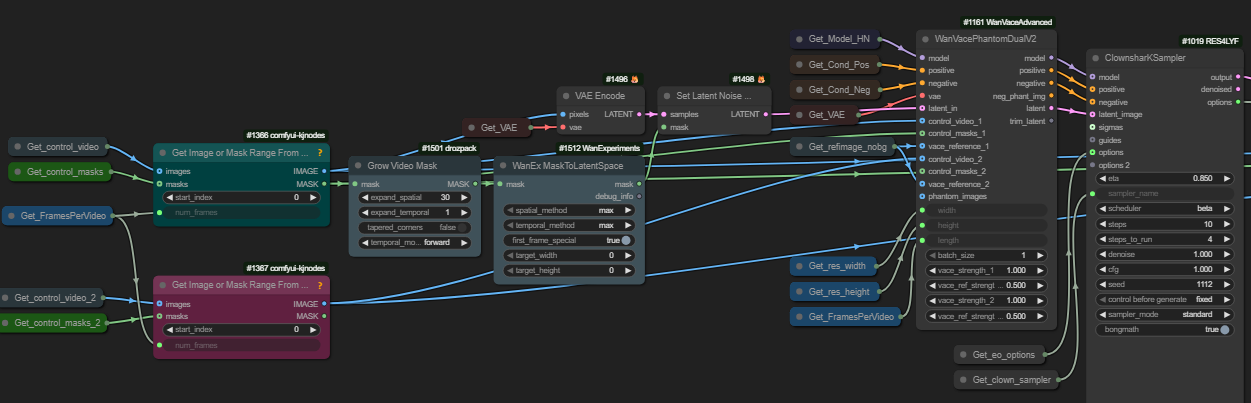
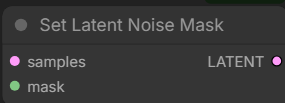
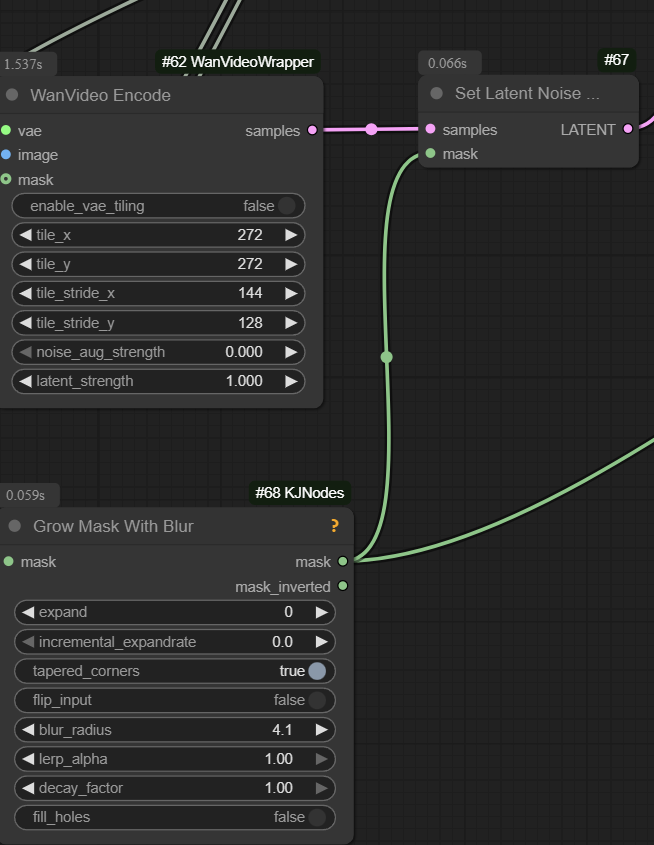
Latent masks can be “feathered” e.g. have gradations of gray in addition to strating white and black. Inside the sampler feathered areas are still translated to full white/black. Threshold for switching changes depending on generation step thus enabling “feathering”.
Latent masks are applicable for image generation as well.
“Model” Masks
Masks which this document refers to as “model” masks to differentiate them from latent masks are masks that are visible to the model. They form part of the data a particular model was trained on. “Model” masks are part of conditioning.
Different models may need “model masks” supplied and populated differently. Well known models that use “model masks” are VACE and Wan I2V.
ComfyUI nodes which generate embeds for these models accept “model masks” as an input.
It is sometimes called temporal_masks.
“Model” masks typically are fully black or white, nothing in between.
Differential Diffusion
Differential diffusion is a particular way to use latent masks in the sampling process.
In wrapper (as of 2025.08.21) differential diffusion is enabled by default and is the only way to do latent masking.
you just add the mask and it’s enabled
In native differential diffusion is enabled in one of two ways
- either by supplying
latent masks“normally” and applyingDifferential Diffusion“model patch” node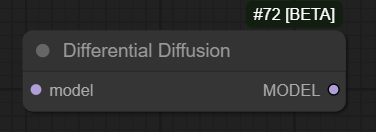
- or by using combined
Differential Diffusion Advancednode from ComfyUI-KJNodes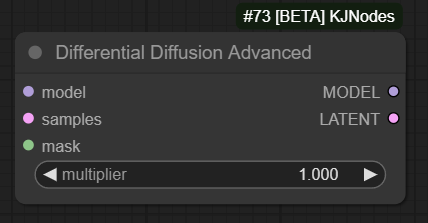
Misc
Sample T2V Latent Mask Workflow
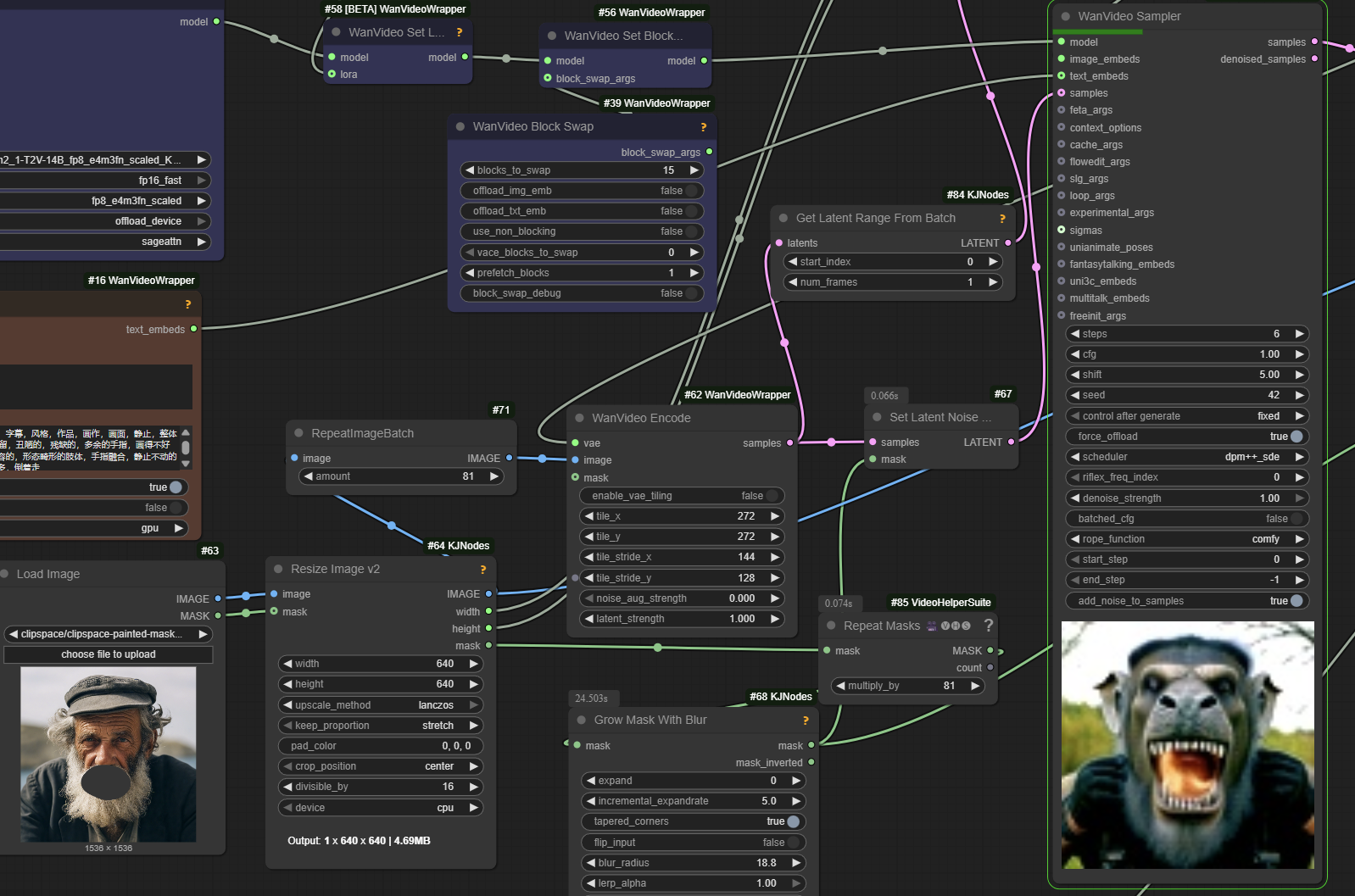
Note: latent masks are separate from VACE masks. Latent masks can and should be blurry. VACE masks possibly need to be binary black/white. Both can be used at the same time in VACE workflows.
In Wrapper if a single frame of latent mask is supplied it is automatically duplicated to match num_frames in the video.